If you’ve ever met a snow-packed ramp, a “temporarily out of order” elevator, or a classroom door that could double as a gym workout… welcome.
“Up to code” is the floor, not the finish line.
Let’s widen the lens—mobility, vision, hearing, energy/pain, and communication—to show what usable today looks like and how to ask for it without going nuclear.
Three real stories (mobility, vision, hearing)
1) Mobility: “The ramp is there.”
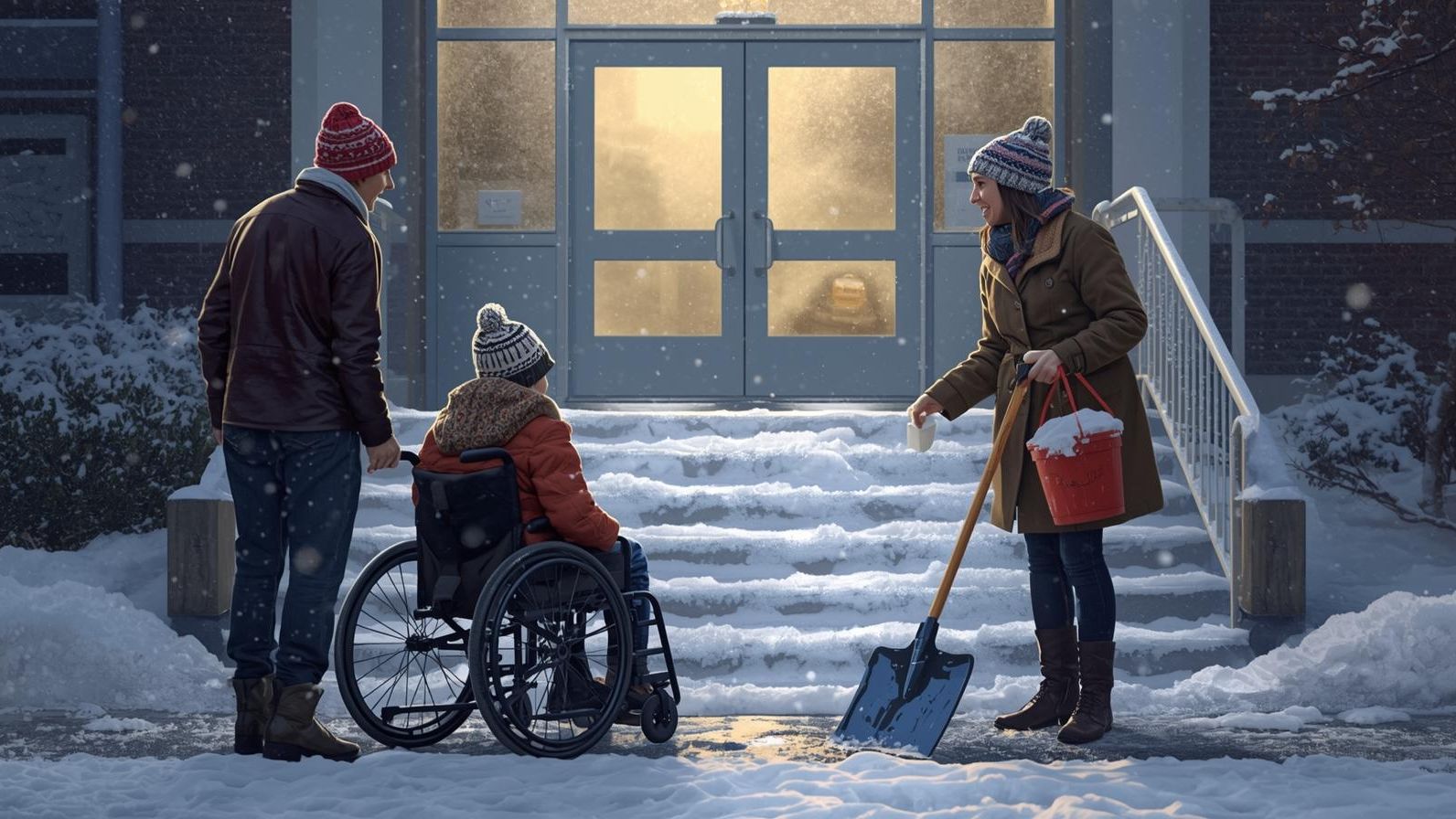
Last winter the ramp existed… under a snowbank. Picture day lines blocked the landing. We ran a 10-minute “map & assign” huddle: caretaker salts ramp and landing before the first bell; office staggers the lineup; teacher shifts one desk. Same week, smooth mornings. Why? Named jobs + times.
2) Vision: “We have yellow stair stickers.”
Maya uses a white cane and has low vision. The school added yellow stickers to stair edges—then waxed the floors to a mirror shine. The glare turned hallways into skating rinks of light. Handouts were 10-point font on glossy paper.
We did a glare walk-through with a timer: curtains open for natural light; no wax near stairs; matte, high-contrast signage; large-print handouts (18–22 pt) and digital copies; one “quiet contrast” path marked with dark tape. Suddenly, Maya could find the lab—and not by guessing.
3) Hearing: “There’s an FM system in the cupboard.”
Jonah is hard of hearing. The classroom had a mic—but it wasn’t charged, and group work turned into a lip-reading Olympics. Videos were played without captions.
We set daily mic routines (charge overnight, teacher wears it, pass the handheld mic during discussion), captions on by default, and front-lighting so faces are visible. The office keeps backup batteries. In assemblies, we booked CART captions and seat placement near the stage lights. Result: Jonah hears the people he came to hear—his classmates.
Name the lesson
Accessibility lives in the details you repeat daily: snow cleared before bell time, captions on by default, high-contrast routes that are never used as storage.
The question is always: Can this student do the same thing, at the same time, with dignity?
What matters & why (plain language + ethical resources)
-
Access is a routine, not a renovation.
Weather, batteries, furniture, and crowd flow change every day.
Takeaway: A 2-minute checklist beats a hallway apology.
Helpful: 211 Canada (211.ca) to find local accessibility supports. -
Lived experience > assumptions.
A 10-minute walk/roll/route test with the student reveals barriers no plan catches.
Takeaway: Test it at rush hour (and in bad weather). -
Communication access is part of the route.
Captions, mics, interpreters, large print, tactile markers, and AAC are not “extras.”
Takeaway: Information must be reachable, not just rooms.
Resources to explore: Rick Hansen Foundation (access checklists), CNIB (vision tools), Canadian Hearing Services (hearing supports).
How-To: Expand the Morning Access Checklist (5 minutes)
Make one list that lives where staff look every morning. Add names and times.
For mobility (wheelchair, walker, crutches):
-
Ramp and landing cleared/salted before first bell (Name @ Time).
-
Automatic door buttons tested; door hold-opens during rush.
-
One 90 cm (3 ft) aisle from door → desk → key stations.
-
Elevator unlocked; key at office + backup with VP.
For vision (blind/low vision):
-
Lights set to reduce glare (no wax near stairs; curtains adjusted).
-
High-contrast tape along priority routes; tripping hazards removed.
-
Large-print (18–22 pt) or digital copies ready; labels in large print and braille if available.
-
Science/tech demos described aloud (“I’m pouring vinegar—clear liquid—into the beaker”).
For hearing (Deaf/HoH):
-
Mic charged and worn; pass handheld mic in group.
-
Captions on by default for every video.
-
Teacher faces class while speaking; front-lighting on.
-
Interpreters/CART booked; seating where sightlines are clear.
For energy/pain/medical devices:
-
Early hall pass (leave 3 minutes before bell crowds).
-
Quiet rest spot arranged; elevator priority noted.
-
Weather adjustments (slippery days = alternate entry route).
For communication (AAC devices):
-
Device charged; backup charger in class.
-
Do not remove the device as “consequence.” It’s a voice.
-
Staff know simple modelling: point to key words while speaking.
Concrete fixes (small wins first)
-
Door weight: Submit a work order (“Room 109 door too heavy—requires two hands”). Use a temporary wedge during transitions.
-
Signage that works: Matte, large print, high contrast, consistent location (left of the door at reachable height).
-
Class layout: Tape the wheelchair lane; create a visual parking spot for backpacks to keep aisles clear.
-
Labs & gyms: Adjustable-height table or sturdy riser; for hearing access, circular seating so faces are visible; for vision, tactile markers on equipment.
-
Assemblies & trips: Ask venues about step-free routes, accessible washrooms on the same floor, captioning options, and lighting. Book interpreters early.
Real-life scripts you can borrow
Parent ↔ Principal (all-disability “route test”)
“Could we do a 10-minute route test tomorrow at 8:15? We’ll check snow/door weight/elevator and captions/print size/glare. I’ll bring a one-page checklist we can post with names and times.”
Parent ↔ Teacher (hearing access)
“When classmates talk, Jonah can’t hear unless they use the mic. Could we try ‘Mic or it didn’t happen’—pass the handheld for every comment? I’ll label it and supply spare batteries.”
Parent ↔ Teacher (vision access)
“Glossy handouts reflect light. Could you post a digital copy and print large-print (18–22 pt) on matte paper? I can provide a quick style guide.”
Parent ↔ Caretaker (mobility access)
“The ramp landing ices first. Could ‘salt landing’ be on your first sweep? I’ll text the office if it’s extra slick.”
Student ↔ Peers (plain, kind)
“I read lips—please face me and speak one at a time.”
“This lane’s my steering path—can backpacks go on hooks? Thanks!”
Pitfalls → What to do instead
-
“We’re up to code.” → “Great—now let’s make it usable at 8:15 in slush and fluorescent glare.”
-
“We have an FM—with last year’s dust.” → Charge nightly; wear daily; pass the mic in groups; captions on by default.
-
“Yellow stickers = vision solved.” → Add matte, high-contrast routes; reduce glare; provide large print & audio descriptions.
-
“The interpreter is for assemblies.” → Access is for all instruction and interactions.
-
“We’ll carry the wheelchair.” → Unsafe/undignified. Clear the route or move the activity.
Teach the community (fast awareness builders)
-
Ten-minute Walk/Roll/Route with staff each term (mobility + vision + hearing).
-
Caption-first habit: “If it plays, it captions.” Post the reminder by the projector.
-
Mic etiquette poster: “Mic or it didn’t happen.”
-
Contrast corners: One low-glare reading nook with matte surfaces and task lighting.
-
Peer Q&A (with student consent): Pre-submitted questions about mobility aids, white canes, hearing aids/cochlear implants, or AAC; model respectful language.
Micro-practice (five minutes this week)
Goal: Add two checks to tomorrow’s morning routine.
Steps:
-
Email: “Can we add Captions ON and Ramp landing salted to the morning checklist with names/times?”
-
Put fresh batteries on the teacher’s desk with a sticky note: “Mic today—thanks!”
Done looks like: Tomorrow’s class starts with a clear route and words everyone can access.
Tools & Resources (Canada-friendly)
-
211 Canada (211.ca): Local accessibility services, equipment loans, community supports.
-
Rick Hansen Foundation (rickhansen.com): Practical accessibility education and checklists.
-
CNIB (cnib.ca): Low-vision tools, print-disability supports, large-print guidance.
-
Canadian Hearing Services (chs.ca): FM/DM, CART, ASL/LSQ interpretation, workplace/school supports.
-
Easter Seals Canada (easterseals.ca): Equipment funding and family resources.
Access isn’t a perk; it’s how we all get to belong. Ramps that are clear, captions that are on, print you can see, doors you can open—these are love notes written in logistics.
Got a fix that worked at your school—best tape, caption routine, mic hack? Share your voice in our 2-minute survey so we can build a parent-tested playbook:
https://forms.gle/4CAw1BJmP2CCxLMMA
-
Disclaimer: Educational, not legal advice. For personal or legal guidance, consult your care team and local human rights resources.