
"The best IPP is one your child can actually use. Not the prettiest document. The most practical one." — Elizabeth Teasdale
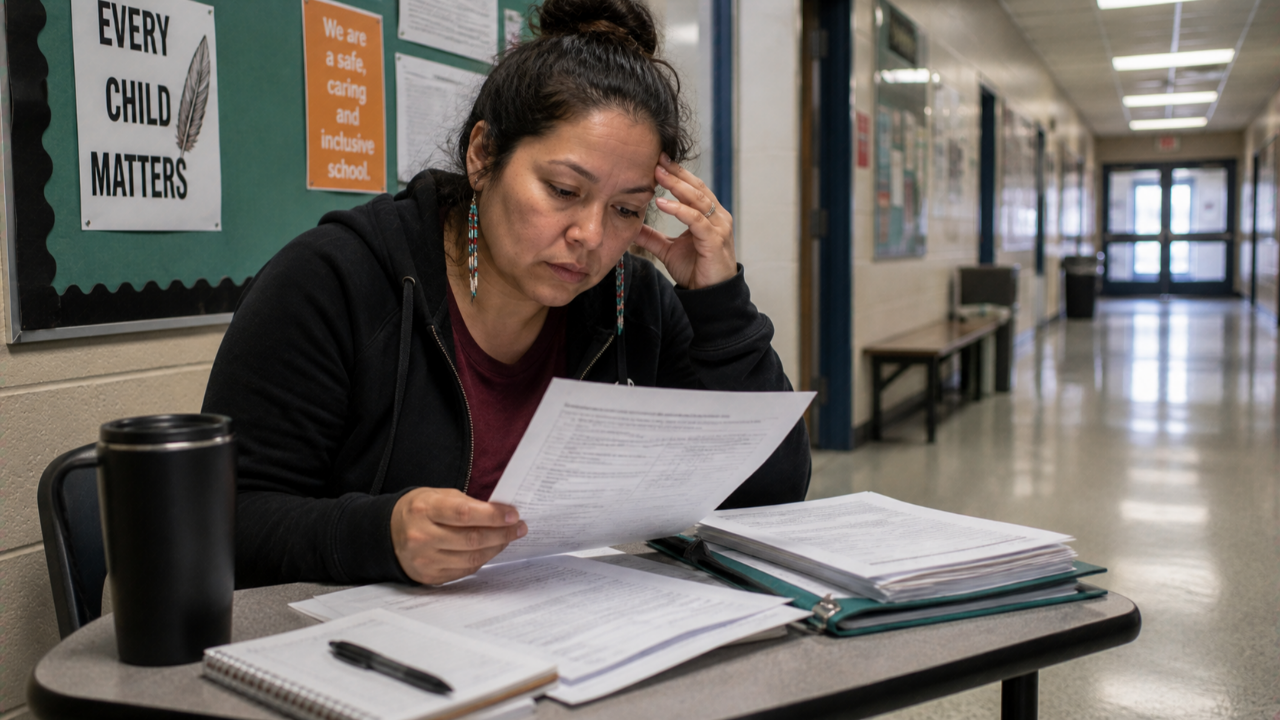
Kokum Margaret spread her grandson Isaiah's Individual Program Plan across the kitchen table, pushing the breakfast dishes aside to make room. Twelve pages. She'd read it three times already.
Isaiah was nine, living with her while his mother was in treatment, and he had ADHD. The school had developed this plan to support him, and Margaret was grateful — she just wished she understood what she was looking at.
The document was full of words she didn't recognize. 'Measurable annual goals.' 'Present levels of performance.' 'Accommodations vs. modifications.' Boxes checked. Percentages noted. References to assessments she'd never seen.
At the bottom of each section was a line for her signature. She'd signed them all at the meeting, because everyone was waiting and she didn't want to seem difficult.
Now, alone with her reading glasses and her tea, she was trying to figure out what she'd agreed to.
This one's for Margaret. And for every parent who has ever signed a document they didn't fully understand, because the meeting was moving fast and the room was full of experts and it felt easier to nod than to ask.
What an IPP Is Actually Supposed to Do
Let's strip away the jargon and get to what these documents are designed for.
An Individual Program Plan (IPP), or IEP/ISP depending on your province, is a written document describing how the school will support a student whose learning needs can't be met through regular classroom instruction alone. It's meant to be a roadmap: where your child is starting from, where they're trying to get to, and how the school is going to help them get there.
At its best, an IPP creates accountability — it documents what the school has committed to provide. At its worst, it's twelve pages of bureaucratic language that gets filed away and forgotten until the next annual review.
Your job as a parent is to push for the first kind and refuse to settle for the second.
The Four Parts Every Plan Should Have
- Present Levels of Performance
This is where your child is right now, academically and functionally. It should be specific: not 'Isaiah struggles with reading' but 'Isaiah reads at a Grade 2 level in Grade 4, with particular difficulty in decoding multi-syllable words.' If this section is vague, push for specifics. Specific current levels make it possible to measure whether the plan is actually working.
- Annual Goals
These are what the school is working toward this year. Good goals are SMART: Specific, Measurable, Achievable, Relevant, Time-bound. A good goal sounds like: 'By June, Isaiah will correctly identify the main idea of a grade-level passage with 80% accuracy, as measured by weekly reading assessments.' A bad goal sounds like: 'Isaiah will improve his reading skills.' If a goal can't be measured, no one can know if it was met.
- Accommodations and Modifications
This is where a lot of parents get confused, so let me explain the difference.
Accommodations change how your child accesses the curriculum — extended time, a quiet testing room, a scribe, text-to-speech software. The content and expectations stay the same; the delivery method changes.
Modifications change what your child is expected to learn or demonstrate. A student working on grade 2 math expectations in a grade 4 classroom is working with modifications.
Both are valid and appropriate in different circumstances. What matters is that the accommodations and modifications in the plan are actually being implemented — which brings me to the most important question you can ask.
- Review and Progress Monitoring
How will anyone know if this plan is working? The IPP should describe how progress will be measured and how often. It should also describe when and how you'll be informed of that progress. If this section is blank or vague, ask for specifics before you sign.
The Question That Changes Everything
Here's a question I want you to bring to every IPP meeting, every review, every check-in with your child's teacher:
"Is what's written in this plan actually happening in the classroom?"
Because here's a truth about educational plans that no one really advertises: there is often a significant gap between what's written and what's actually happening.
An accommodation that isn't implemented isn't an accommodation. It's just words on paper.
If your child's plan says 'extended time on tests' and they're not receiving extended time, that's not a planning problem — it's an implementation problem, and it needs to be named as such.
Red Flags to Watch For in Any IPP
- Goals that are vague or unmeasurable ('will improve in reading')
- Goals that haven't changed from last year's plan, even if they weren't met
- Accommodations listed but no plan for how they'll be tracked
- No mention of how parents will be kept informed of progress
- Language that describes your child's deficits without any mention of strengths
- A plan that looks identical to every other IPP you've seen — boilerplate rather than personalized
You Have the Right to Ask for Changes
You signed the plan. That doesn't mean you're locked in. IPPs can and should be revisited when circumstances change, when goals are met early, or when something isn't working.
You can request a review meeting at any time. You don't have to wait for the annual review. If you believe the plan isn't being followed, document your specific concerns and request a meeting with the resource teacher or principal.
Margaret eventually brought her questions to the resource teacher. It turned out two of Isaiah's accommodations — movement breaks and preferential seating — weren't happening consistently, because the supply teacher who covered two days a week hadn't been briefed. One conversation. One email to the substitute coordination. Problem fixed.
She couldn't have had that conversation without understanding what the plan was supposed to say.
Learn the language. Read the document. Ask the questions. You belong in this conversation.
This post is part of the You Are Not Failing: Education Advocacy series. For general educational purposes only — not legal or professional educational advice. Download the IPP Review Checklist below to use at your next meeting.
🌼 Want the Ipp Iep Review Checklist?
Grab your free copy — it is yours to keep, print, and come back to whenever you need it.
[ Get the Free Toolkit ]