
When “Advocating” Turns Into “Rescuing”: Raising Capable Kids Without Carrying Everything
Aug 11, 2026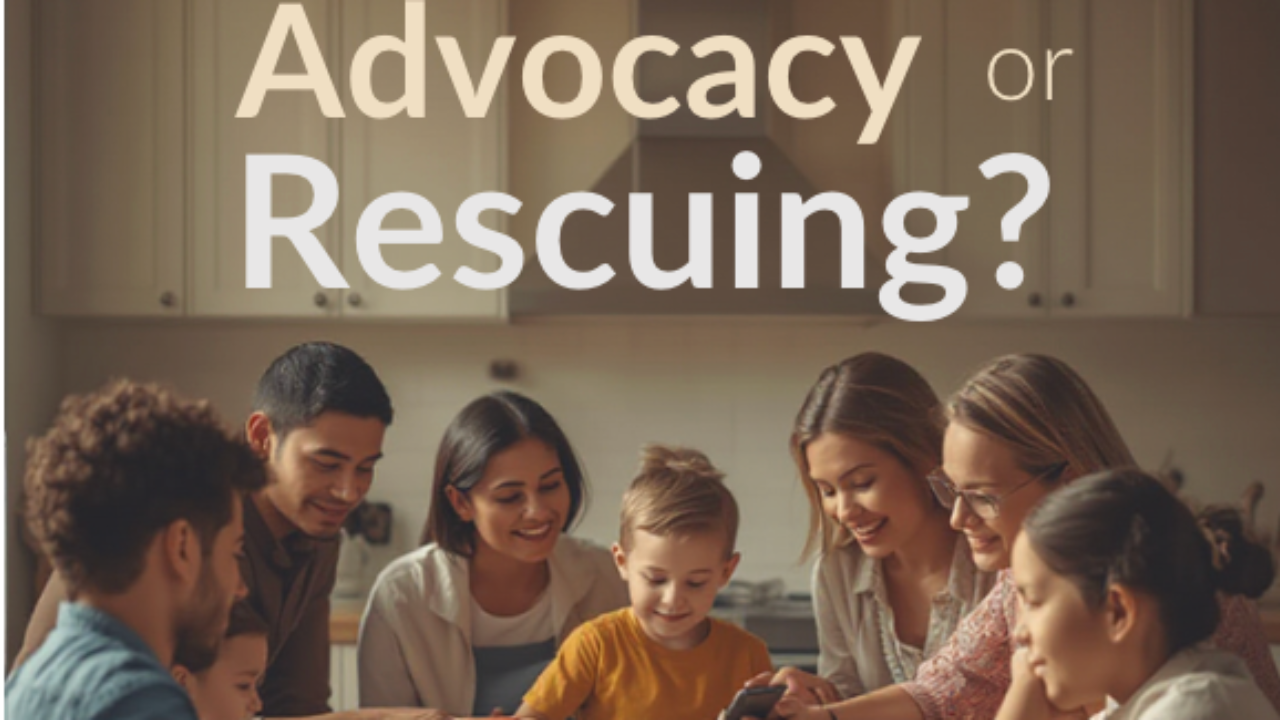
Finding the sweet spot between showing up for our kids… and raising kids who can show up for themselves.
Picture this: you’re in your kitchen, phone in hand, typing a message to the teacher/coach/other parent that is somehow turning into a three-part documentary series. Your kid is upset. You’re upset. Your protective instincts are doing parkour.
This is the parenting line we all walk:
-
Advocacy = “I’m helping my child access fairness, safety, and support.”
-
Over-advocacy (rescuing) = “I’m removing every bump so my child never has to build skills.”
And you know what makes it hard? Both can look the same in the moment: a parent stepping in.
Let’s sort it out with compassion, practical tools, and the kind of realism that recognizes you are parenting in a world that is… a lot.
Why we over-advocate (and why it makes sense)
Most of us over-advocate for the same reasons:
-
We love our kids fiercely.
-
We’re tired, overloaded, and have limited patience for “systems.”
-
We’ve seen what can happen when kids don’t get support.
-
Some of us were not advocated for as kids… and we promised we’d do it differently.
Also, some kids truly need more adult support—especially kids who are neurodivergent, multi-abled, anxious, traumatized, or navigating racism, sexism, homophobia/transphobia, poverty, or being new to a country. Advocacy can be life-changing when it levels the playing field. Child Mind Institute+1
So the goal is not “step back.”
The goal is step in wisely.
What the research says about “too much control”
A big chunk of research on “helicopter parenting” (over-controlling or over-involving) links it with things like higher anxiety/depression symptoms and weaker coping skills later on. Frontiers+2American Psychological Association+2
On the flip side, autonomy-supportive parenting—warmth + structure + letting kids have appropriate choice and responsibility—tends to support better well-being and motivation over time. Self Determination Theory+1
Translation in mom-language:
Kids do best when they feel loved, guided, and capable. Not loved, guided, and micromanaged.
The Thrive Momma “Advocacy Filter”
Before you jump in, run it through these 5 questions:
1) Is this a safety issue?
-
Physical safety (injury risk, threats, weapons, unsafe driving, severe bullying)
-
Mental health crisis or self-harm talk
If yes: You step in. Big. Fast.
2) Is this a rights / access / fairness issue?
-
Disability accommodations, discrimination, harassment
-
A school not following agreed supports
If yes: You step in—firmly and documented.
3) Is this a developmental skill my child needs to learn?
Examples:
-
Handling disappointment, negotiating, apologizing, emailing a teacher, asking a coach what to improve
If yes: You coach, but don’t rescue.
4) Is this my child’s problem… or my anxiety?
No shame. Just honesty. (I ask myself: “Am I trying to calm my kid—or calm me?”)
5) What’s the smallest effective action?
Aim for the lightest touch that still protects safety and dignity.
Advocacy vs enabling: a super-clear distinction
Child Mind Institute describes a helpful frame: supporting is doing what helps a child grow; enabling is doing what keeps a child stuck. Child Mind Institute
A quick gut-check:
-
Supporting sounds like: “I’ll help you practice what to say.”
-
Enabling sounds like: “I’ll call and fix it so you don’t have to feel uncomfortable.”
The “Ladder” approach: Do less over time
Try this 4-rung ladder:
-
You do it (rare; crisis/safety/rights situations)
-
You do it with them (you speak, they listen/learn)
-
They do it with you nearby (they lead, you back them up)
-
They do it (you debrief after)
Your job is to keep moving down the ladder over time.
This pairs beautifully with what pediatric guidance often emphasizes: boundaries + autonomy + steady connection. AAP
Real-life situations (with a sane response plan)
Scenario A: “The coach didn’t give me enough play time.”
Usually: skill-building zone.
Try:
-
Validate first: “That feels unfair. I’d be mad too.”
-
Move to curiosity: “What does your coach say you need to work on?”
-
Teach a kid script (see below).
Parent email (light-touch version):
“Hi Coach [Name], I’m supporting [Child] to learn how playing time decisions work. Could you share what you’re looking for in practices/games so they know what to focus on? Thanks for coaching them.”
This is advocacy that builds capacity—not a demand to change outcomes.
Scenario B: “My teacher is picking on me.”
This one hits parents right in the nervous system.
Here’s the truth:
-
Kids can be honest and incomplete reporters.
-
Teachers can be caring and overwhelmed.
-
Both things can be true.
Step-by-step:
-
Regulate (don’t write the email yet).
-
Ask open questions (below).
-
Look for patterns, not one-off moments.
-
Ask the teacher for a collaborative check-in (not a courtroom trial).
Child Mind Institute emphasizes warm communication and asking direct questions as part of effective advocacy. Child Mind Institute
Parent email script (collaborative):
“Hi [Teacher Name], I’m noticing [Child] feels discouraged about [subject/class]. I’d love your perspective on what you’re seeing and what would help. My goal is to support learning and confidence at home too. Could we do a quick call or email exchange this week?”
If there’s a rights or safety issue (harassment, discrimination, threats), you go firmer and document immediately.
Scenario C: “My teen got caught with drugs.”
This is serious, and it’s also a moment where parents can swing into panic-control (understandably).
Your targets here are:
-
Safety
-
Accountability
-
Treatment/support
-
Long-term relationship
In Canada, Health Canada has a “get help with substance use” resource page that can connect families to support. Canada
Drug Free Kids Canada also provides parent-friendly, evidence-informed info and conversation tips. Drug Free Kids Canada
What over-advocacy can look like here:
-
Trying to “make it disappear,” blaming everyone else, shielding from all consequences.
What wise advocacy can look like:
-
Getting professional support, setting clear boundaries, staying connected, and not pretending it’s “handled” because you yelled once.
A steady parent line:
“I love you too much to ignore this. We’re going to get help, and there will be consequences. I’ll stay with you through the consequences—but I won’t remove them.”
(And if you’re dealing with immediate risk or intoxication, that’s medical/safety territory—get urgent help.)
Scripts that build confidence (instead of dependence)
1) Script for your child: “Do you want comfort, coaching, or backup?”
“Okay—tell me what happened. Do you want me to:
-
just listen,
-
help you plan what to say/do, or
-
come with you as backup?”
This teaches your child they have options—and responsibility.
2) Script for your child to talk to a teacher
“Hi [Teacher], I’m struggling with [thing]. I’ve tried [effort]. Could you tell me what you’d recommend I do next?”
If your child is neurodivergent or anxious, you can practice it as a role-play, write it down, or record it as a voice note.
3) Script for your child to talk to a coach
“Coach, I want to improve. What’s one thing I should focus on this week?”
Simple. Brave. Effective.
4) Script for you when you’re about to go full Mama Bear
“I’m feeling protective right now, so I’m going to pause before I respond. My goal is to help my child become capable—not just comfortable.”
(Yes, you can roll your eyes while you say it. It still works.)
Signs we’ve crossed into over-advocacy
No shame—just awareness. Over-advocacy often shows up as:
-
You solve problems before your child attempts.
-
Your child panics at normal discomfort (because discomfort always gets removed).
-
Teachers/coaches start saying, “Please have your child speak to me directly.”
-
Your kid blames others for everything and avoids skill-building.
-
You’re exhausted because you’re carrying problems that aren’t yours to carry.
A tiny plan for this week: “One skill-building moment a day”
Pick one daily moment to practice the ladder:
-
Let them order their own food.
-
Let them email the teacher (you review it).
-
Let them try the homework problem first.
-
Let them apologize to a friend (you coach the words).
You’re not stepping back from love.
You’re stepping toward long-term strength.
When to step in immediately
If your child is in danger or talking about harming themselves, get help right away.
In Canada, you can call or text 9-8-8 for suicide crisis support. Canada+1
Kids/teens can contact Kids Help Phone (call 1-800-668-6868 or text CONNECT to 686868). Kids Help Phone+1
Closing thought (from Elizabeth, standing at the kitchen counter with you)
Advocacy is love in action.
But the goal of advocacy isn’t to make life smooth.
The goal is to make our kids safer, steadier, and more capable—with us close enough that they feel brave.
🌼 Want the Advocating vs Rescuing Toolkit?
Grab your free copy — it is yours to keep, print, and come back to whenever you need it.
[ Get the Free Toolkit ]