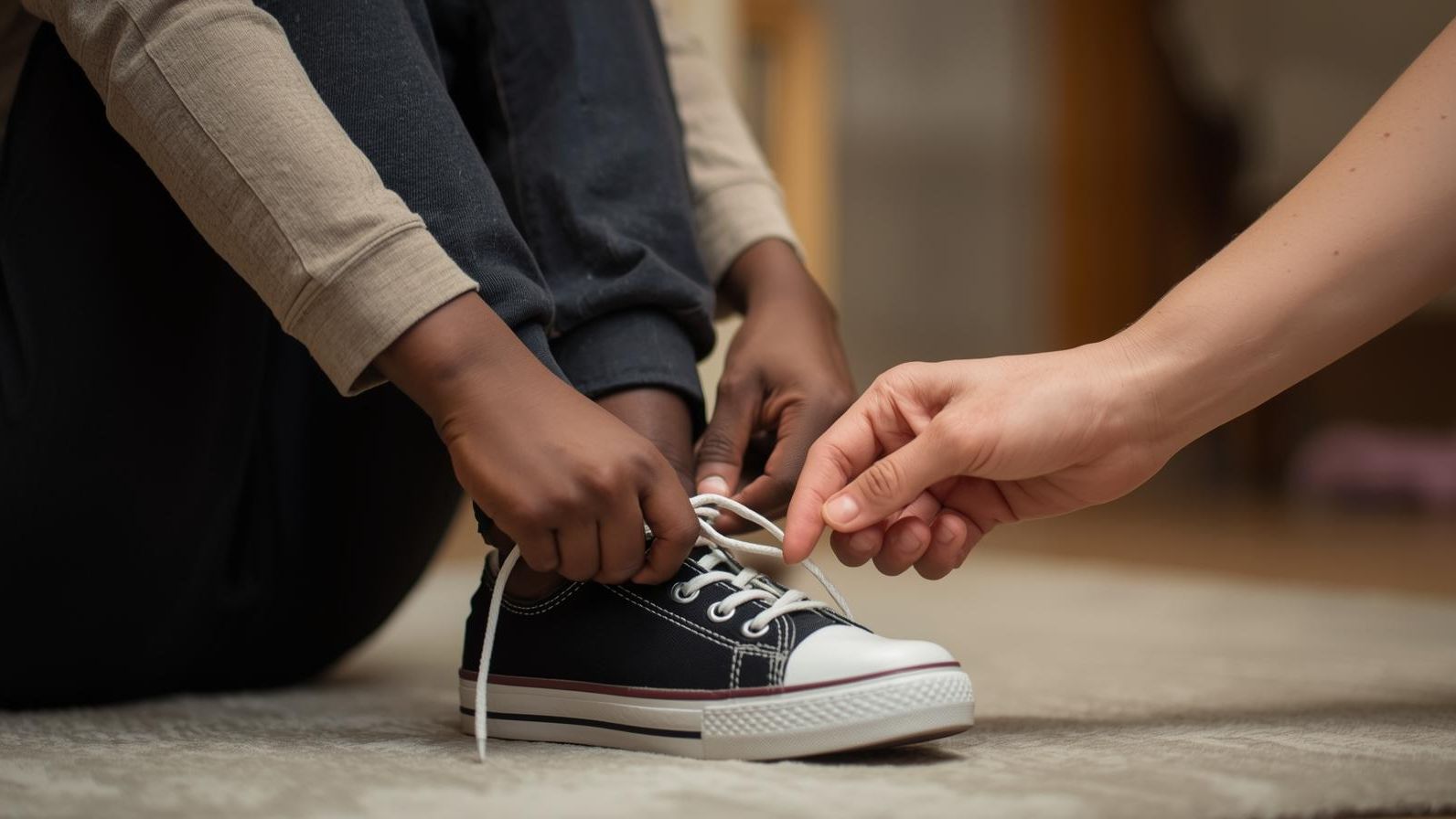
Ever tried to teach a kid to tie laces and felt your soul leave your body?
Me too. Velcro tried to save us, but then came basketball tryouts.
If you’ve met clumsy falls, wobbly buttons, and “where did the backpack go… again,” welcome. We’re talking dyspraxia, also known as Developmental Coordination Disorder (DCD)—and how to help without losing the relationship (or your mind).
In grade one I “learned” to tie my shoes by pretending my desk had gum on it and hiding my feet. Years later, my son and I nearly broke up over bunny ears. We both cried; the laces looked smug.
Then I learned what many of you are discovering: some brains have a tougher time planning and carrying out physical sequences—especially under pressure. That has a name. It’s common. And there are so many ways through. Once we swapped shame for strategy, our evenings got calmer, and—spoiler—he made the team.
Name the Lesson
Dyspraxia/DCD affects how the brain plans, sequences, and coordinates movement. It can touch fine motor (buttons, scissors, handwriting), gross motor (balance, running, catching), organization (backpack, time), and even everyday routines (getting dressed, using cutlery).
It’s not laziness. It’s wiring.
Skill grows in tiny steps—especially when we adapt the task and the environment.
What Matters & Why (research-informed, plain language)
-
Dyspraxia = Developmental Coordination Disorder (DCD).
Same umbrella idea, different terms in different places. Many kids are bright and motivated; the challenge is motor planning and coordination.
Why it helps: Names lead to supports, not blame.
Learn more: CanChild (McMaster University, Canada) explains DCD in family-friendly language.
Takeaway: The label guides help; it doesn’t define your child. -
It shows up differently at each age.
Toddlers may bump or trip; school-age kids may struggle with printing, scissors, copywork, and sports; teens may find organization, note-taking, driving prep, and fitness routines hard.
Why it helps: Expect change; adjust supports.
Learn more: Hospital/health non-profits explain milestones and strategies (e.g., HealthyChildren, CAMH).
Takeaway: Needs shift; support can too. -
Adaptations + practice = progress.
Occupational therapy (OT), physiotherapy (PT), visual supports, and “just-right” challenges grow independence.
Why it helps: Changing the task or tools unlocks success and confidence.
Learn more: Public health/education sites list services; 211 Canada helps you find local OT programs.
Takeaway: Modify first, practice small, celebrate often.
Dyspraxia in Plain Language (with examples)
Other names you’ll hear:
-
DCD (Developmental Coordination Disorder) — the term often used in clinical settings.
-
Dyspraxia — a widely used everyday term.
-
Note: “Childhood apraxia of speech” is a separate speech-motor diagnosis. Some kids may have both, but one doesn’t equal the other.
How it can look at different ages (examples, not a checklist):
-
Early years: Late to crawl/walk, bumps into furniture, avoids playground ladders, hates scratchy socks, drops the spoon, struggles with puzzles.
-
Elementary: Messy printing, slow copywork, “floating” letters, trouble opening lunch containers, can’t tie laces or do buttons quickly, PE is stressful.
-
Middle school: Dislikes ball games, tires easily, avoids group sports, backpack is a black hole, loses track of steps in multi-part assignments.
-
Teens: Dreads labs that require fine motor precision, struggles to learn manual tasks (bike repair, cooking), organization/time management is heavy, driver’s training needs extra practice.
Sensory side-quests (often travel with DCD):
-
Touch: You know how wool can feel itchy to you? For some kids, any seam or tag can feel like a cactus.
-
Sound: Gym echo and hand dryers can feel like a siren in your skull.
-
Sight: Fluorescent flicker = instant headache.
-
Taste/texture: Mixed textures (hello, fruit-on-the-bottom yogurt) can be a “nope.”
Small sensory fixes (softer fabrics, quieter spots, simpler textures) make learning movement so much easier.
How-To: Concrete Supports (small wins first)
-
Backward-chain the skill (5–10 min).
You do all the steps except the last one; your child does the last step (the easy win). Next time, they do the last two steps, and so on.
Example: For laces, you set the cross-over and “bridge,” your child pulls the final knot tight.
ND-friendly: Keep steps to 3 or fewer at a time; use a visual card. -
Use “good-enough” tools (set-up once, use daily).
-
Elastic or lock laces, zipper-sided high-tops, or BOA dials for sports.
-
Pencil grips, slant boards, thick markers, mechanical pencils.
-
Button hooks, zipper pulls, magnetic shirts, elastic waistbands.
Why: Independence now builds confidence for harder practice later.
-
Practice when everyone’s calm (3–5 min).
Short reps after snack, not during the morning rush. Add music, a timer, and a silly cheer.
ND-friendly: Use a visual timer or a two-song playlist; stop while it still feels successful. -
Chunk & cue (1–2 min, repeatable).
Say and show one step at a time: “Cross → Loop → Around.” Point to a card with those three words/pictures.
Language tip: Use the same words every time. -
Body double (5–10 min).
You do a parallel task (folding tea towels) while your child practices laces beside you. Brains love company and rhythm. -
Switch the stage (as needed).
Start with laces on a practice board on the table (easier posture), then move to a shoe in the lap, then to the foot.
Sports: Pre-lace at home; keep spare lock laces in the gym bag. -
Praise the process, not just the result (10 seconds).
“Nice steady hands.” “You kept trying after the loop slipped.” Skill grows where attention goes.
“But Can They Still Join the Team?”
Yes. Absolutely yes. Some ideas:
-
Shoes: Elastic/lock laces or zip-sided high-tops that tighten evenly. Pre-tighten at home; coach checks once.
-
Warm-up: Offer options that build coordination without public pressure (ladder drills on the side, wall passes).
-
Roles: Rotate positions; defensive roles may need less ball handling at first.
-
Coaching note: “Player is practicing laces; using lock-lace shoes for safety. Needs one reminder for tied hair/hoodie strings. Responds well to short cues and visual demos.”
-
Belonging matters: Team photos, jersey day, and bench cheer captain are wins too.
Real-Life Scripts
Kid ↔ You
Kid: “I can’t do it.”
You: “Totally fair—it’s tricky. I’ll set it up; you do the last pull. Then we high-five and eat grapes.”
Coach ↔ You
You: “We’re using lock laces so he’s safe on the court. Could warm-up include a few wall-pass reps before scrimmage?”
Coach: “Easy. I’ll add a visual station.”
Teacher ↔ You
You: “Printing is slow. May we try keyboarding for longer writing and a slant board plus pencil grip for short work?”
Teacher: “Yes—send the tools; I’ll add extra time.”
Pitfalls → What To Do Instead
-
“Try harder.” → Try smarter. Change tools and break the task into tiny steps.
-
Practicing only when rushed. → Practice calm. Two minutes after snack beats ten in the doorway.
-
All-or-nothing shoes. → Bridge solutions. Elastic laces now + a weekly five-minute tie practice.
-
Comparisons to siblings/teammates. → Compare to yesterday. “Last week you did one pull; today you did two.”
-
Endless lectures. → Show + do. Three steps on a card and one quick demo.
Micro-Practice (five minutes this week)
Goal: Build a Laces-Without-Tears routine.
Steps:
-
Thread elastic/lock laces into one pair of everyday shoes.
-
Print or draw a tiny card with three words: Cross → Loop → Pull. Tape it to the shoe box.
-
After snack, practice one minute on a shoe in the lap. You set it up; they do the last pull. End with a sticker or fist bump.
Done looks like: Your child can do the last step without help and leaves the practice smiling (or at least not scowling).
Where to Get Help (Canada + beyond)
-
211 Canada (211.ca): Find local occupational therapy, recreation programs, and funding options by postal code.
-
CanChild (canchild.ca): Evidence-based guides on DCD for families, teachers, and coaches (McMaster University).
-
Kids Help Phone (kidshelpphone.ca): 24/7 support for youth and caregivers (call 1-800-668-6868 or text CONNECT to 686868).
-
CAMH (camh.ca): Hospital-based information on mental health and learning differences.
-
HealthyChildren (healthychildren.org): Plain-language pediatric advice (American Academy of Pediatrics).
(Ask your family doctor/nurse practitioner for OT/PT referrals; speak with your school about accommodations—keyboard use, extra time, alternative assessments.)
You’re not “behind.” You’re on a different staircase with smaller steps and better handrails.
Laces today, left-hand layups tomorrow—there’s room for both and the kid who loves the team photo most of all.
Got a tip that saved your sanity—or a shoe brand that worked? Share your voice in our 2-minute survey so we can build a community list of parent-tested tools:
https://forms.gle/4CAw1BJmP2CCxLMMA
Disclaimer: Educational, not medical advice. For personalized guidance, consult a licensed professional (OT/PT/physician).
P.S. On the blog page, invite readers to click the “Chat here” button and drop their favorite adaptations—elastic laces, zipper-sided highs, or the world’s best pencil grip. Your idea might be someone else’s big win tonight.